On February 7, 2018, the Partnership for Resilience and Preparedness launched their map-based platform, titled “PREPdata”, to provide easy access to the information that adaptation decision-makers need to assess vulnerability and build resilience to climate change. [1] This platform compiles data from a wide array of reliable sources and provides them to the public with the intention of making people more aware of both past and future climate conditions. The Partnership explains that the biggest challenge facing climate change mitigation is the lack of accessibility to reliable data. The goal of PREPdata is to “open the lines of communication between data providers and users–and by providing easy access to a curated set of data and tools, which is driven by user input.” [1] As an open source platform, PREPdata creates a much more collaborative and effective approach to help governments and citizens understand both the past effects and future risks of climate change.
PREPdata is a map-based, open data online platform that allows users to access and visualize spatial data reflecting past and future climate, as well as the physical and socioeconomic landscape for climate adaptation and resilience planning. [1] The platform is continuing to evolve through the input of PREP partners and PREPdata users. It is a flexible tool for climate adaptation planning, designed to address many of the gaps and challenges adaptation practitioners face. Some of the features of the site include a customizable, visual, map-based platform, active curation of datasets, a commitment to global coverage, and user-needs based strategy for platform development, utilizing the knowledge and network of the partners and platform users to enable continuous improvement. [1] PREPdata is primarily run by the World Resources Institute and Future Earth, yet also accumulates data from a number of private and public institutions including NASA, the Department of Commerce, and the National Oceanic and Atmospheric Administration.
PREP published several articles about local governments that have used their data in order to better prepare themselves for climate change. For example, Sonoma County in California has applied PREPdata to support climate resilience planning, with a focus on changes that could affect the wine-growing and tourism-dependent region. In India, PREPdata is being used to support climate adaptation plans in two Indian states – Uttarakhand and Madhya Pradesh – through the development of state-level dashboards to track key indicators of climate hazard, vulnerability and adaptation. [2] The Uttarakhand project was particularly interesting to me as they used a wide array of data found through the site in order to measure the potential prosperity of the region. They considered factors like temperature change and the likelihood of landslides, floods, and other natural disasters in order to measure socio-economic effects on the region and the potential to grow tourism. [2] All this would not have been possible if it had not been for PREPdata accumulating all different types of resources that may not have been available to the local North Indian government.
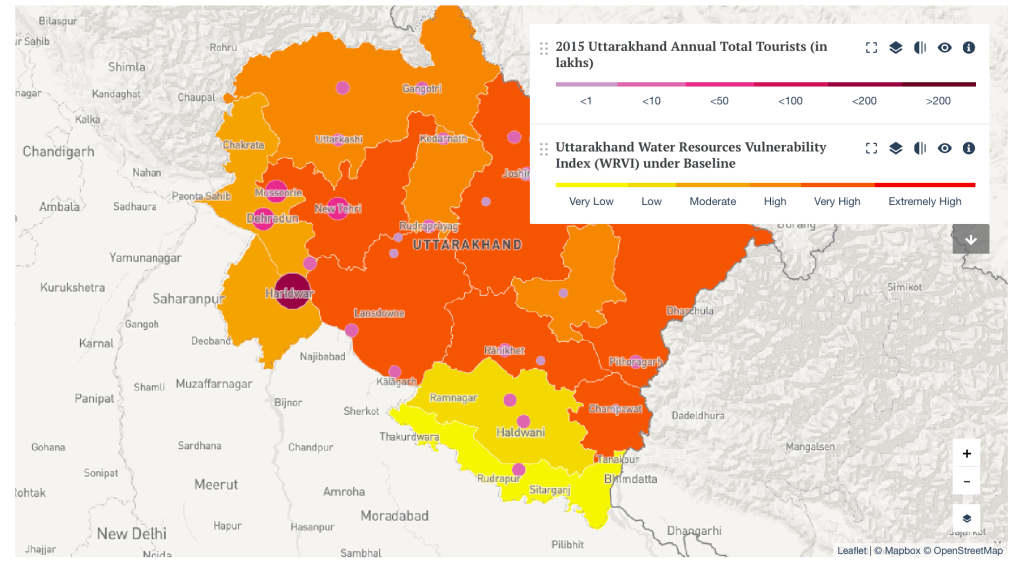
Since climate change is a global issue, rather than relying on your own government’s info. PREP works with governments across city, state, and national levels in order to use the platform as a resource in their attempts to prepare for climate change. This allows governments and organizations to compile data from a wide array and look at it in a very advanced interactive map platform in order to better understand a wide array of environmental effects ranging from temperature rises and greenhouse gases to natural disasters. Making this platform open source is extremely advantageous as we all work together to protect our planet.
Bibliography
- “PREPdata About.” Partnership for Resilience and Preparedness, http://www.prepdata.org/about.
2. “Uttarakhand: Climate Change in the Tourism and Agriculture Sectors.” Partnership for Resilience and Preparedness, http://www.prepdata.org/stories/uttarakhand-climate-change-in-the-tourism-and-agriculture-sectors.
3. Will, Bugler. “New Open-Source Data Platform for Climate Resilience Launches Today: Acclimatise – Building Climate Resilience.” Acclimatise, 7 Feb. 2018, http://www.acclimatise.uk.com/2018/02/07/new-open-source-data-platform-for-climate-resilience-launches-today/.
 Paul Rodriguez's Blog