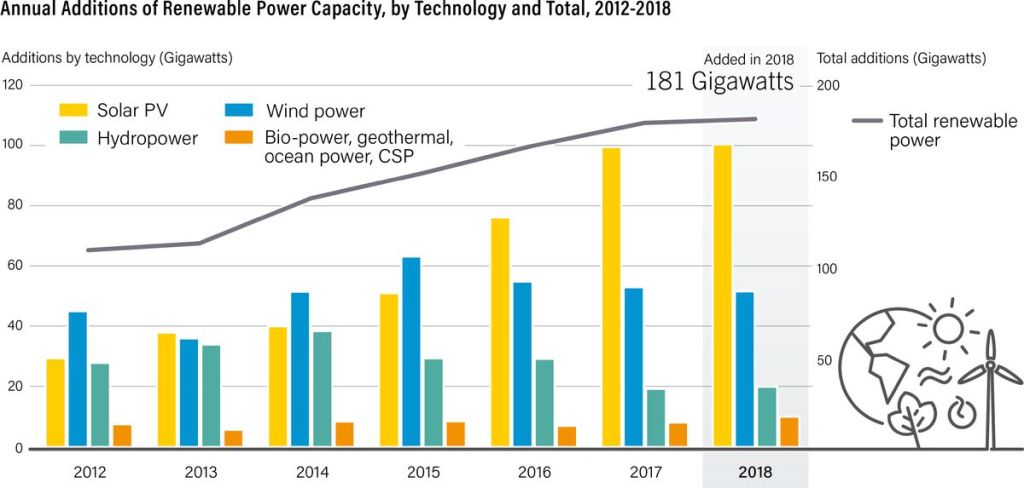
While fossil fuels and other non-renewable sources have dominated the energy sector in the past, renewable energy has become a much more viable option in recent years. According to the Center for Climate and Energy Solutions, renewable energy is the fastest-growing energy source globally where 24% of the energy generated in 2015 came from renewable sources such as biomass, geothermal, solar, hydro, wind, and biofuels. This is expected to increase to 31% by 2040 and will heavily depend on a number of factors including the development of technologies to make these energy sources cost-effective.[i]
Closed sourced, proprietary technologies have created many hurdles in the renewable energy sector. Up until very recently, renewable energy operators have relied on closed-source technologies that were created and distributed by the original equipment manufacturers. Unfortunately these softwares were optimized to manage the specific equipment, not the overarching energy solution. These proprietary softwares are also extremely expensive to license and very slow to adapt to the energy sector’s needs. Further, each of these proprietary equipment softwares speaks a different language. Arjan R. Stam, the director of network management at Alliander (a premiere Dutch energy company) explains that “As utilities we don’t cooperate much, we don’t have the pleasure of sharing information with each other.”[ii] He continues that, “Nowadays it takes a long time to bring a new station online… in large part because of the need to integrate the various technologies in a power station with the existing infrastructure. New code has to be written to get parts to talk with one another.” In these ways, closed-source software is limiting the renewable energy sector’s efficiency and adaptability as well as increasing the cost of expansion and innovation.
In order to minimize costs and grow as quickly as possible, renewable energy firms like A&S Energie have implemented open source solutions to great success. A&S Energie is a Belgian biomass plant that supplies electricity to 55,000 households. For years, A&S Energie suffered from a dependence on high-cost, “largely manual, error-prone and time consuming process[es]” where human operators were forced to record data. [iii] This outdated system only produced readily available data for three months. Any data older than that had to be manually uploaded into a SCADA system. But A&S was able to replace their solution with Factry Historian which features an open-source, time-series database as well as an open-source dashboard for management and operators to use. Operators have always known that in order to predict energy needs, minimize costs and have equipment run optimally, data is required. This is especially true when working with nature as the energy source. Energy like wind, hydro, or solar are not constant and therefore require operators to adapt their equipment regularly to changes in the environment. Now that A&S Energie’s database is open-source, all of their data is readily accessible to plant managers, operators, consumers as well as other renewable energy companies. Rederik Van Leekckwyck, Factry’s Project Lead for A&S Energie, reports that A&S Energie save 10% per day on reporting by using a full-open source software stack.[iv] Further, having access to all of the data at once has allowed them to catch errors in their system and avoid extremely costly downtime.
SAM Open Source is another example of how open source technology has elevated the renewable energy space. Recently, The U.S. National Renewable Energy Lab (NREL) has made all of the source code for their System Advisor Model (SAM) open source. SAM allows utility companies, small consumers and large companies to execute detailed, accurate financial analysis on their energy consumption. SAM has been free to use for many years but by going open-source individual users (consultants, companies, real estate developers) can adapt the code to their own needs. [v] Further, because the source code is available to read, advanced users can see how the models work underneath the hood, thus allowing them to decide whether or not SAM is a good fit for them. Lastly, SAM’s open-source code allows the community to fix bugs and new features creating a culture and system of innovation in the notoriously slow-moving renewable energy industry.
Climate change has taken center-stage worldwide as we are beginning to see the negative effects our dependence on non-renewable sources of energy are having on our weather and environments. Many industrious entrepreneurs have been hard at work on renewable energy companies to change Earth’s course, but they are encountering many technological hurdles. By moving towards open-source solutions, engineers, plant managers, financial institutions and governments will be able to communicate data faster, easier and more transparently which will give us a better chance at saving our planet.
Works Cited
1. “Renewable Energy.” Center for Climate and Energy Solutions, 16 Dec. 2019, www.c2es.org/content/renewable-energy/.
2. Finley, Klint. “To Go Green, the Energy Industry Goes Open Source.” Wired, Conde Nast, 12 Oct. 2019, http://www.wired.com/story/go-green-energy-industry-open-source/.
3. POWER. “Why Open Source Works for the Renewable Energy Sector.” POWER Magazine, 29 Aug. 2018, www.powermag.com/blog/why-open-source-works-for-the-renewable-energy-sector/.
4. van Leeckwyck, Frederik. “How Factry’s Industrial Historian Solution Helps A&S Energie Generate Electricity Efficiently.” InfluxData, 20 June 2018, www.influxdata.com/resources/how-factrys-industrial-historian-solution-helps-as-energie-generate-electricity-efficiently-faster-and-with-more-confidence/.
5. “Home.” NREL System Advisor Model (SAM), sam.nrel.gov/about-sam/sam-open-source.html
 Paul Rodriguez's Blog